ASME B16.5 · B16.47 Reference
Weld Neck Flanges
How tapered-hub, butt-weld flanges work, where they're used, and how to spec them.
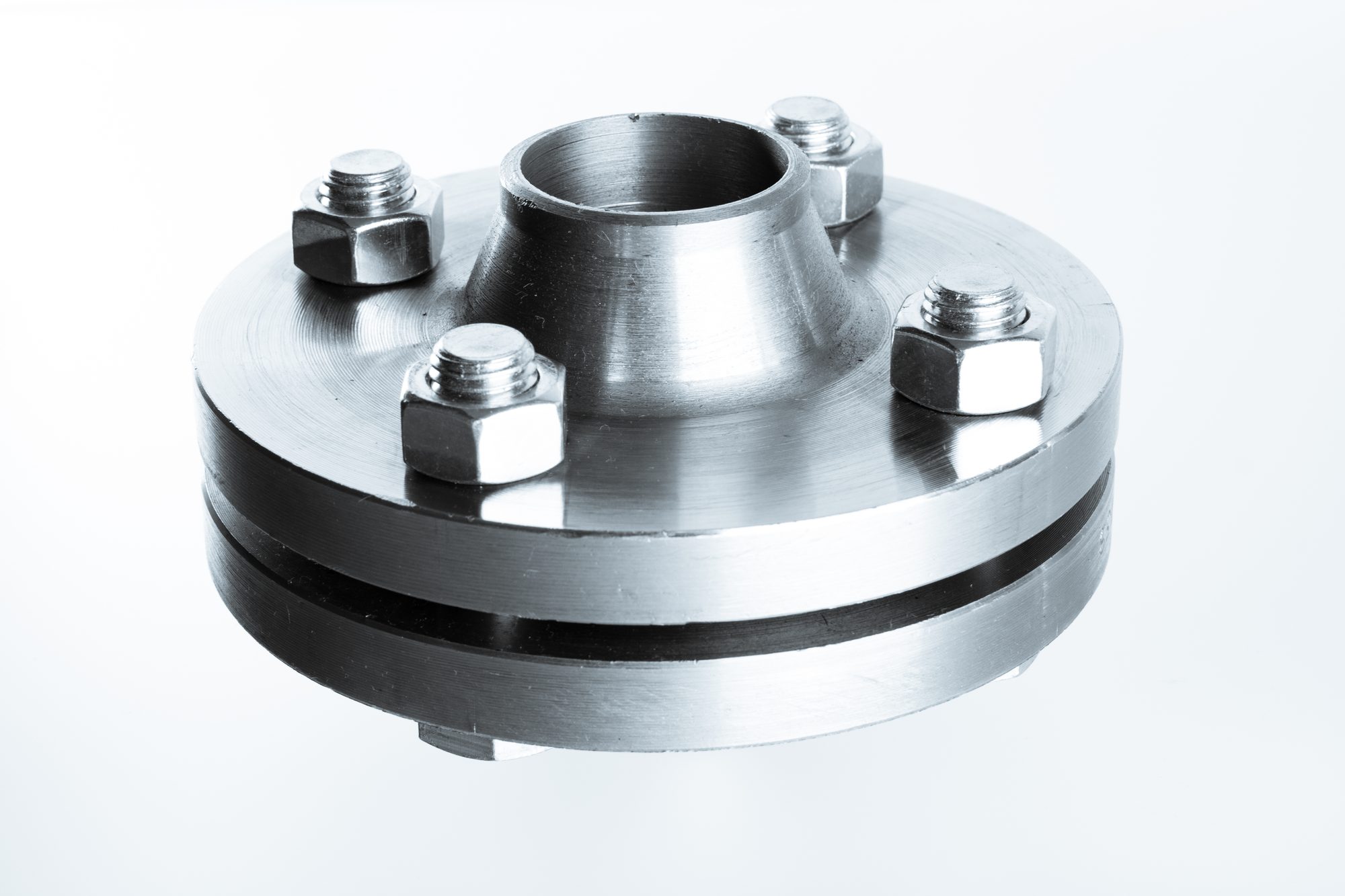
ASME B16.5
NPS 1/2 to 24
ASME B16.47
NPS 26 to 60
Materials
Carbon, stainless, alloy
How a Weld Neck Flange Works
A weld neck flange has a tapered hub and a weld bevel. It butt-welds to matching pipe. ASME B16.5 covers NPS 1/2 to 24. ASME B16.47 covers the large weld necks, NPS 26 to 60. Weld necks are used in oil and gas and other industrial service, in carbon, stainless and alloy.
This is the type, not the dimension table. If you need OD, bolt circle, hub length, or bore, use the class tables on texasflange.com.
The joint
Pipe and hub get matching bevels. The shop puts a full-penetration circumferential butt weld around that V. After weld and inspection, the bore is a smooth transition. Flow does not hit a step the way it can on a slip-on fillet. The tapered hub spreads load from the flange ring into the pipe wall. That is why higher class, higher temperature, and cyclic service default to weld neck.
Bore is a schedule callout. A weld neck bored to the pipe ID, not to NPS, is the usual order. Specify the schedule or the ID. Standard-bore columns on the tables are not every wall.
Facing follows the spec: RF on most process work, RTJ when the class and the mate demand a ring groove. RTJ weld necks with a metal ring gasket are common on higher-pressure oil and gas. Match the face. Do not mix RF and RTJ.
Long weld neck (nozzle)
A long weld neck is a different part. ASME B16.5 subsection 2.8 calls it a straight hub welding flange and does not tabulate it the way a standard weld neck is tabulated. Tank and vessel shops use it as a one-piece nozzle: flange plus barrel, no pipe weld at the shell. Square-cut end is typical, not a weld bevel. Bore is often the nominal size, not a pipe schedule, unless the print says otherwise. Length is on the drawing.
Long-weld-neck tables are published by class, including Class 150 and Class 600 standard connections. Heavy barrel and equal barrel are separate geometries. Send the length, barrel OD, and grade. Do not treat a long weld neck as a standard weld neck with extra hub. The weld prep and the bore rules are different. Nozzle connections are machined with varying wall thickness when the vessel outlet needs more metal. Carbon, stainless, and nickel alloys are all in play on a nozzle RFQ.
Numbers live on the tables
OD and bolt counts are not reprinted here. Weld neck type page · B16.5 hub tables · Class 150 · LWN Class 150 · LWN Class 600
Why Weld Neck
The Construction Type That Handles Anything
A weld neck flange has a tapered hub that meets the pipe at a matched weld bevel. The geometry does two things at once: it provides a smooth, gradual stress transition from pipe wall to flange ring (better than slip-on for cyclic and high-temperature service), and the full-penetration butt weld creates a near-seamless joint that meets radiographic acceptance. That is why weld neck shows up on every line where the pressure, temperature, or cycle count matters.
Grain Continuity
Forged weld necks carry continuous grain from pipe-end through hub through ring, oriented with the load path. Cyclic and fatigue service rewards this construction more than any other.
Pressure Headroom
The hub absorbs bolt-up bending without yielding the way a flat slip-on flange ring does. That is why Class 1500 and above are almost always weld neck construction.
Radiographic Joint
The matched weld bevel allows full penetration butt welding with 100 percent NDE on the joint. Required for ASME pressure vessel service and recommended on any line where leak risk carries safety consequences.
Why Are Weld Necks The Ideal Flange?
Weld neck flanges are the go-to choice for most piping applications - and for good reason. They feature a neck extension with a weld bevel at the end, which lets them connect directly to pipe in a way that feels almost seamless. In larger sizes and higher pressure classes, you'll rarely see anything else used. If there were only one bored flange style to choose from, the weld neck would probably win every time (yes, you still need a blind flange to cap the line off).
Here's how the connection works: the weld bevel meets a matching bevel on the pipe end in a V-shaped joint, allowing for a clean, circular weld all the way around. The result is a smooth, unified transition that lets gas or liquid flow through with very little restriction. After welding, the joint gets inspected to make sure the seal is solid and free of any defects.
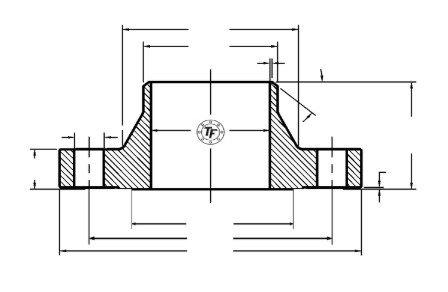
Another thing that sets weld neck flanges apart is the standardized, tapered hub. Rather than an abrupt change between pipe and flange, the hub creates a gradual shift that spreads out pressure forces more evenly at a nice angle, like the slope of a mountain. This makes a real difference in high-pressure, high-temperature environments where stress and shock are constant concerns - the extra material along that transition helps absorb it all.
Because weld necks are the standard for high-pressure applications, they're often paired with a ring type joint (RTJ) face. This sealing surface uses a metal gasket that gets compressed between the grooves of two connecting flanges, forming an exceptionally tight seal. Combined with the strength of the weld bevel connection, an RTJ weld neck with a metal gasket is the top pick whenever the stakes are high, and are even required in some specifications such as for API 6A flanges.
The Pressure Spectrum
From Lightweight to 20K PSI
The same weld neck construction scales from waterworks to wellhead. The class number changes, the material gets heavier, the hub gets taller, but the geometry stays the same.
Class 125LW
150-175 psi
Lightweight steel weld neck on the ANSI B16.1 Class 125 bolt pattern. Waterworks, HVAC, low-pressure process. Plate-cut or forged from A36 or A516-70.
AWWA C207 B / D / E / F
86 to 300 psi
Waterworks weld neck flanges per AWWA. Class D is the workhorse at 175 psi. Class E and F handle high-service transmission. Plate-cut from domestic-melt A36 or A516-70 with AIS option.
ASME B16.5 Class 150 to 2500
285 to 6170 psi at 100°F
The plant process workhorse. Catalog sizes 1/2 inch through 24 inch. Carbon A105, stainless F316L, chrome-moly F22 and F91. Raised face, flat face, ring-type joint, tongue-and-groove facings.
ASME B16.47 Series A / B
Through 6170 psi
Large diameter weld neck flanges 26 inch through 60 inch. Series A heavier MSS pattern, Series B lighter API 605 pattern. Class 75 through 900.
MSS SP-44 Pipeline
Class 600 to 2500
Pipeline weld neck flanges matched to API 5L X-grade pipe. A694 F42 through F70 grades. Class 600 through 1500 covers most transmission service. Charpy impact testing standard.
API 6A / 6BX 2M to 25M
2000 to 25000 PSI
Wellhead, BOP, and high pressure production weld necks. 6B series for 2M through 5M. 6BX series for 10M and above with self-energizing ring gaskets. Material classes from AA standard to HH severe sour.
WHY US?
1/2" – 203" INDUSTRIAL FLANGES
We provide:
ANSI / ASME FORGED FLANGES
MSS-SP-44 FLANGES / ANSI B 16.47 SERIES A
API TYPE 6A – RTJ Face Flanges
API-605 FLANGES / ANSI B 16.47 SERIES B
A.G.A. ORIFICE UNIONS – With or without Hardware
ASME BOILER CODE FLANGES
CL. 125 LIGHTWEIGHT FLANGES – Low pressure
PLATE FLANGES – 1/4″ thru 8″ Thick, AWWA C-207
ANSI LONG WELDNECKS & SPECIAL BODY CONNECTORS
STUDDING OUTLETS (pad flanges)
SPECTACLE BLINDS – Line blinds, paddle spacers
DIN FLANGES / JIS FLANGES / Special Ring Flanges
Materials Used
CARBON STEEL
ASTM/ASME SA-105, A-350 LF-2, LF-3, A694, SA-516-70, A36
CHROME ALLOYS
A-182-F-1, F-5, F-6, F-9, F-91, F-11, F-12, F-22
STAINLESS STEEL
A-182: F-304, 304/304L, 316/316L, 304H, 316H, 309, 310, 317L, 321, 347, 347H, 904L, Alloy 20, and other H grades
SPECIALTY ALLOYS
Hastelloy B-2, C-276, G, X, C-22 | Inconel 600, 601, 625, 718 | Incoloy 800, 825, 800H, 800HT | Monel 400
ALUMINUM
3003, 6061, 5083 and other grades upon request
OTHER MATERIALS
Copper 90/10, 70/30 | Duplex F51/2205, F53/2507 | Titanium Gr2, Gr12
Grade selection by service: materials guide.
Technical Resources
Engineering Reference
Flange Dimension Reference
ASME B16.5 and B16.47 dimensional tables for weld neck flanges. OD, BC, bolt count, hub geometry by class.
RTJ Gasket Reference
R-series and BX-series ring gasket dimensions, material options, and matching flange groove designations.
API 6A / 6BX Guide
Pipeline and wellhead pressure classes. 2M through 25M. Ring gasket family selection and material class system.
Bolt Torque Calculator
B7 stud torque values by flange size and lubrication condition. Reference values for cross-pattern bolt-up.
Hastelloy Service Guide
C-276, C-22, B-2 grade selection. Corrosion data for chloride, acid, and chemical process service.
Pressure-Temperature Lookup
ASME B16.5 P-T values for common materials. Class 150 through 2500 across carbon, stainless, chrome-moly.
Common Questions
Frequently Asked
What is a weld neck flange?
+
A weld neck flange has a tapered hub and a weld bevel. It butt-welds to matching pipe. ASME B16.5 covers NPS 1/2 to 24. ASME B16.47 covers the large weld necks, NPS 26 to 60.
How is a weld neck flange joined to the pipe?
+
Pipe and hub get matching bevels. The shop puts a full-penetration circumferential butt weld around that V. After weld and inspection, the bore is a smooth transition. Flow does not hit a step the way it can on a slip-on fillet.
Why are weld necks used in high-pressure and high-temperature service?
+
The tapered hub spreads load from the flange ring into the pipe wall. That is why higher class, higher temperature, and cyclic service default to weld neck. In larger sizes and higher pressure classes, you'll rarely see anything else used.
Should a weld neck flange have an RF or RTJ face?
+
Facing follows the spec: RF on most process work, RTJ when the class and the mate demand a ring groove. RTJ weld necks with a metal ring gasket are common on higher-pressure oil and gas. Match the face. Do not mix RF and RTJ.
What is a long weld neck flange?
+
A long weld neck is a different part. Tank and vessel shops use it as a one-piece nozzle: flange plus barrel, no pipe weld at the shell. Square-cut end is typical, not a weld bevel. Do not treat a long weld neck as a standard weld neck with extra hub. The weld prep and the bore rules are different.
What pressure range can a weld neck flange cover?
+
The weld neck construction itself scales further than any other flange type. At the low end, Class 125LW lightweight weld necks per AWWA C207 handle waterworks service down to 150 to 175 psi working pressure. ASME B16.5 covers Class 150 through Class 2500 in standard catalog sizes, which spans 285 psi through 6170 psi at room temperature for A105 carbon. Above that, API 6A and 6BX weld necks reach 20000 PSI and beyond. One construction type, the full pressure spectrum.
Why pair RTJ facing with a weld neck flange?
+
The metal-to-metal seal of a ring-type joint flange depends on bolt-up force and material stiffness to compress the gasket into the groove. The weld neck hub geometry distributes that bolt-up force evenly into the pipe wall without overstressing the joint, which is why RTJ + weld neck is the default at API 6A 3M class and above. The combination is also required by some refinery and petrochemical specifications for high-temperature steam and cyclic service.
What is Class 125LW and how does it differ from cast iron Class 125?
+
Class 125LW is a lightweight steel flange that shares the bolt circle, bolt count, and outside diameter of ANSI B16.1 Class 125 cast iron. The hub is shorter and the ring section is thinner, which reduces weight without compromising bolted joint integrity for the moderate pressures (typically 150 to 175 psi) of waterworks and HVAC service. The advantage over cast iron is ductility: steel does not crack from impact or bolt-up overtorque the way cast iron does.
When does Hastelloy weld neck make sense over stainless?
+
Hastelloy C-276 is to nickel alloys what A105 is to carbon. It resists wet chlorine, hot mineral acids, ferric and cupric chlorides, formic and acetic acids, sea water, and hypochlorite. Stainless F316L tolerates dilute chloride at room temperature but pits and stress corrosion cracks in concentrated chloride above 140 degrees F. Once the service crosses into hot wet chloride or mixed-acid chemistry, C-276 weld necks are the qualified product.
Are weld neck flanges available with NACE MR0175 compliance?
+
Yes. NACE sour service flanges in A105, A350 LF2, A694, F22, F91, and F316L are available with the supplementary hardness testing and chemistry restrictions the standard requires. The MTR shows the hardness data, the heat treatment record, and the NACE annex applicable to the order.
How large can a weld neck flange be?
+
ASME B16.5 caps at 24 inch nominal. ASME B16.47 Series A and B cover 26 inch through 60 inch. Above 60 inch, weld neck construction continues as custom-fabricated hubbed plate flanges, with the hub rolled or cast separately and welded to the plate-cut flange face under full penetration weld with 100 percent NDE.
Request a Quote on Weld Neck Flanges
Send the size, pressure class, facing, bore or schedule, and material grade.
Phone: 281-484-8325
Request a Quote